The Shadowfell and the Feywild are reflections, or echoes, of the material plane, which encompasses the familiar world the Lamplighters know. Here are a few key details to help envision both locations:
The Shadowfell: Ableak, desolate place full of decay and death. The most striking and immediate impression a visitor to the Plane of Shadow experienced was the lack of color and light; no sun, moon, or stars adorned the vault of the inky black sky, and all things looked as if the color had leeched out, leaving nothing but black and white, which in the dimness were more like “dark black” and “light black”. Air, water, and food existed on this plane, supporting plants, animals, and some humanoids adapted to the shadow environment. Visitors could survive indefinitely if they were willing to endure thick, foul-smelling water, food that oozed dark blood, and a pervasive nip of cold in the air. A visitor could never feel warm, would often hear or sense the presence of things that weren’t there, and could never shake the feeling of being watched. It was a constantly unsettling place.
The Feywild: The Feywild was the place from which fey originated, and from where the first elves arrived in Faerun. It was a place of unrestrained and awe-inspiring natural beauty, always bathed in twilight of the setting (or perhaps rising) sun. Visitors to the plane found that all sensations, both sensory and emotional, were heightened. Smells were stronger, colors were more vivid, and sounds were clearer, but at the same time shadows were darker and impulses were harder to control. Eladrin were the beings that had the closest thing to a civilization in the Feywild. They were the descendants of the elves that never left the Feywild, and over the millennia had become suffused with the plane’s primal magic; those with no fey ancestry might find their memories of time spent in the Feywild going hazy, if not vanishing altogether.
With the campaign resuming soon, it might be helpful to remind our adventures all your options for the ACTION stage of your turn. Remember, each turn consists of your MOVEMENT, ACTION, and BONUS ACTION or REACTION for specific skills. On your turn, you can use your action for any of the following:
Players can now explore the Wilds of Faerun. Different regions and environments offer different challenges, experiences, and rewards. When the party finds itself in a town or village, there are further options.
The basic steps to exploring the wilds are:
Buy Provisions (prices listed below, Each party member can carry up to 5 days’ worth, up to 35 days’ provisions with the full party.
Roll travel dice according to region; harsher environments reduce the amount of days players can travel on one rest. Example: For a road, players roll a d8; for a swamp, a d4.
Add/Subtract 1 day for each character with Invigoration or Exhaustion.
Check for adventure. Players roll to see if an adventure imposes itself with the d20, or can seek it voluntarily. adventures may be dangerous or fanciful; they may be battles, puzzles, or mysteries. Often, but not always, adventure leads to treasure. Adventures always take at least one day.
Subtract provisions used from total.
Roll for rest and invigoration. If no long rest is taken, players roll for invigoration with advantage. Players with exhaustion must get a long rest before they can gain invigoration.
(optional) Search for a merchant and re-provision. Finding a merchant is more difficult in harsher environments.
Example: PCs buy 10 days’ provisions. They roll a 1d8 for travelling by road, getting a 7. Three players have invigoration (+3), while two are exhausted(2), for a net of (+1). Players then travel for 8 days. PCs then roll a 12 on the Adventure table, meaning no adventure presents itself, but they choose to see what’s happening in the area because they want to try to find treasure or gain experience. A battle ensues, and the players find a nice hoard of gold, but this takes another day’s provisions for a total of 9 days’ provisions used. Players then again rest and roll for invigoration. They have only 1 days’ provisions remaining, so roll a 16 to find a merchant from whom they buy another 8 days’ provisions with the treasure they won. When this is done, they roll the travel dice again for the next leg of the journey.
Provision Prices:
Comfortable:90% chance of long rest + 20% chance of invigoration. . 4 GP per day per character 28 GP per day (party) 280 GP per tenday
Modest: 75% chance of long rest + 10% chance invigoration. 10% chance of exhaustion. 2 GP per day per character 14 GP per day (party) 140 GP per tenday
Poor: 50% chance of long rest+ 5% chance of invigoration. 20% chance of exhaustion. 1 GP per day per character. 7 GP per day (party) 70 GP per tenday
Squalid: 25% chance of long rest, 25% chance of exhaustion. 50 SP per day per character 4 GP per day (party) 40 GP per tenday
Wretched:10% chance of long rest, 50% chance of exhaustion. 1 SP per day 7 SP per day (party) 70 SP per tenday
Destitute: 5% chance of long rest. 75% chance of exhaustion , 5% chance of critical event. 50 CP per day
As mentioned in the post Treasure and You: New Game Mechanics, the Lamplighters will have the opportunity to gain a new boon to help them explore the wider realms of Faerun: Invigoration.
What is Invigoration and how does a player gain it?
What is Invigoration and what does it do? Invigoration represents the idea that your character is well-rested and has a good state of mind, making her or him more useful in and out of combat. In-game, it grants advantage on a one-use basis for any attack roll, ability check, or saving throw; alternatively, it can be used to re-roll damage on an attack or spell, but the second roll must be used.
How do I gain Invigoration? Characters gain Invigoration upon a successful d100 roll when attempting to take a long rest*; the required number is dependent upon the quality of Provisions the party is using. It can also be granted by the DM instead of Inspiration or gained throughout the course of play in certain circumstances.
How long does Invigoration last? It depends. When travelling across country, invigoration affects how many days the group can travel. In a dungeon, it is only good for one game day. Once it is spent, it is gone until the player gains Invigoration again. It is the opposite of Exhaustion**.
What else can Invigoration do? If a player does not use their Invigoration in the course of travelling or during an encounter, (or during one game day in a dungeon), it grants the player advantage when rolling the d100 check for the following day and prevents exhaustion for that roll, giving the character a much better chance to remain Invigorated for the following game day.
How do I remember if my character is Invigorated? Players will be given a silver stone to mark whether or not they have Invigoration. When it is used, players return the stone to the DM.
Easy! Remember, the quality of your provisions affects your chances at gaining invigoration, but provisions are expensive, so go get that treasure!
Helpful Reminders:
When the party takes a Long Rest, there are now four potential outcomes: A: The player succeeds in gaining the normal benefits of a long rest and gains Invigoration. B: The player succeeds in gaining a long rest but does not gain Invigoration. C: The player fails to take a long rest. D: The player fails to take a long rest, reaps no benefits, and gains one level of Exhaustion*
For example:
You have paid for enough Modest Provisions to last 10 days. For 10 game days, when attempting to take a long rest, each member of the party rolls 1d100.
According to the table, Modest provisions grant 10% chance of invigoration, 75% chance of a Long Rest, and 10% chance of exhaustion.
Mercy rolled a 60, so gains a long rest but not invigoration. (Better than 25, but not better than 90). Thurmack rolled a 4, so does not gain a long rest, and gains a level of exhaustion. (Not better than 10). Luna rolled a 91, so gained a Long Rest and Invigoration. (Better than 90). Eldrich rolled a 20, so does not gain a long rest, but neither does he gain a level of exhaustion. (Not better than 25, but not below 10).
Therefore:
The party sets out toward their destination, the Bad Tower of Wickedness. It takes about nine days of travel through a forest to get there. A nominated PC rolls for Forest Travel, (1d8), to show how many days the characters can travel before they need to re-roll. A 4 is rolled; the party gets -1 for Thurmack’s exhaustion–an exhausted character slows the group down–but +1 for Luna, (an Invigorated character speeds the party up), so the outcome is still 4 days.
The party progresses for 4 days of the 9. At this juncture, a d20 is rolled to see if they have an encounter along the way. They roll better than 10, so the encounter may be avoided; however, they also don’t gain any experience or treasure. Players can still opt to seek an encounter if they wish, thus gaining any potential rewards from it. If they had rolled below a 10, the encounter would not be optional.
This process repeats until the characters reach the Bad Tower. Upon entering the tower, invigoration only lasts between long rests.
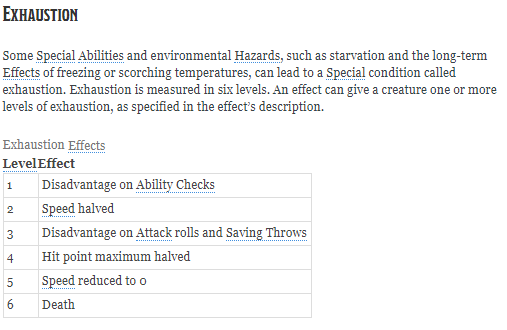
The rules for Exhaustion are detailed on page 291 of the Player’s Handbook. They are:
The impossible has happened: a dragon attacked Waterdeep. The Open Lord hasn’t been seen in public for weeks. The Masked Lords are mired in bureaucracy, entangled in members’ own conflicts of interest, and ill will has begun to spread. The City of Splendors is vulnerable. The ripple effect across Faerun has been swift and widespread. Cities and powers are vying for economic control; on the Sword Coast, merchants are heading for Baldur’s Gate and Neverwinter, who have already begun a trade war with one another by loosening laws regarding the sources of money and taxes.The nation of Amn is controlling the cost of iron and has stationed soldiers at the pass through the Cloud Peaks. The Orcs of the Many-Arrows Tribes have raided farms and villages surrounding Mirabar to the north. The Zhentarim are amassing weapons and armour and command numerous trading routes in every country. Price gouging is common, guards are more susceptible to corruption, and organized crime has seen a rise. Every guild, faction, and militia are hoarding treasure and powerful artifacts. Adventurers possessing famous or coveted weapons are being harassed to sell them–or worse. Many already have been found dead. The cost of goods and weapons has increased dramatically, including necessities. From the largest cities to the smallest villages across the world, desperation drives good people to dark places, and greed sows unspeakable evils. To make matters even worse, there are rumors of more dragon attacks…
Everyone is afraid.
What does it all mean for the party?
It means that now, treasure matters more than ever before. Adventuring across wilds and through dangerous dungeons, all while defending against frightening monsters, takes a physical and emotional toll on characters, as well as wears out their gear; as such, a long rest while camping no longer guarantees benefits; your equipment, provisions, and state of mind all help dictate how rested you are–up and at ’em, or sore and bleary–but better provisions give you a better chance of gaining the benefit of a long rest. Thus, the party’s relative wealth affects how travel, inns, and provisioning work; as the world grows more inhospitable, your ability to obtain gold and jewels has become more necessary for survival. It also means you can pay for faster modes of travel and, by investing in your wellbeing, potentially gain invigoration, the ability to re-roll an attack, a skill check, or even a damage roll. Staying at an Inn has more benefits, but is also more expensive and has its own pitfalls.
Fast travel: you can now fast travel from town to town for 50 SP per mile (250 GP=500 miles) along any marked road (bonuses/discounts from your Cartographer depending on destination). Destinations off road are possible, but might require hiring a guide and will cost more. (Between sessions only to allow the DM to plan)
Inns:You have 100% chance of long rest at any inn, plus the following benefits, depending on the quality of your rooms; however, having better rooms makes you more conspicuous, which might help–or hurt–your chances at gaining information at local watering holes. Lavish: 12 GP per character. 55% chance of invigoration Comfortable: 10 GP per character: 45% chance of invigoration. Modest: 8 GP per character: 35% chance of invigoration Poor: 6 GP per character: 25% chance of invigoration Squalid: 4 GP per character: 15% chance of invigoration, 10% chance of exhaustion.
Provisioning: When leaving town, the party will estimate how many days’ (long rest’s) provisions they’ll need to get there (if not fast travelling) and buy the appropriate amount at a quality of their choosing. Having better provisions results in more benefits from resting, but leaves less money for other purchases. If provisions run out before the party reaches a town, the quality of provisions can drop by one level each day; this becomes more likely as supplies dwindle. Players will roll a d100 on each long rest to determine its benefits–or penalties.
Comfortable:90% chance of long rest + 20% chance of invigoration. . 4 GP per day per character 28 GP per day (party) 280 GP per tenday
Modest: 75% chance of long rest + 10% chance invigoration. 10% chance of exhaustion. 2 GP per day per character 14 GP per day (party) 140 GP per tenday
Poor: 50% chance of long rest+ 5% chance of invigoration. 20% chance of exhaustion. 1 GP per day per character. 7 GP per day (party) 70 GP per tenday
Squalid: 25% chance of long rest, 25% chance of exhaustion. 50 SP per day per character 4 GP per day (party) 40 GP per tenday
Wretched:10% chance of long rest, 50% chance of exhaustion. 1 SP per day 7 SP per day (party) 70 SP per tenday
Destitute: 5% chance of long rest. 75% chance of exhaustion , 5% chance of critical event. 50 CP per day
Treasure is now more important than ever–and you have a good reason to go after it when you have the opportunity. Will you gather the wealth of kings, or starve to death in the dark? The dice, of course, will have their say.
Although the Lamplighters (and the Faerun they know and love) reside on the Prime Material Plane, our heroes have also traveled to the Feywild, a realm of cloying faerie magic, felt the cold touch of the melancholy Shadowfell, defeated ravenous demons of the Abyss and defied their eternally vigilant and nefarious enemies, the devils of the Nine Hells. They’ve been ambushed by Phase Spiders whose natural habitat is the Ethereal Plane and are attempting to close a rift between their world and the great maelstrom of the Elemental Chaos.
So how does it all fit together? Faerun’s scholars have debated that very question for centuries. The current, most prevalent model is that of the Great Wheel:
This sigil shows how The Prime Material Plane, (where Faerun exists–as do other worlds, according to scholars), is mirrored by the Shadowfell and Feywild. These are surrounded by the Ethereal Plane, which is itself nested inside of the Elemental Chaos. Together, these comprise the “Inner Planes”.
Beyond their borders, scholars surmise, are the planes of Law, Chaos, Good and Evil–where the Gods reside. Each of these is unique and a dimension unto itself in the great Astral Sea, beyond which only the rawest forms of positive and negative energy exist. Some believe there may be more even further out…
Other planes and ways to travel between them are the business of no-gooders, greedy adventurers, evil cultists, insane wizards, and highfalutin’ scholars; it isn’t here nor there to your average merchant or sheepherder, beyond praying for good fortune or lots of wool. But for those whose paths cross these ephemeral barriers, and whose task it has become to defend against evils emerging therefrom…well, it pays to know what you can. The Wheel spins the fate of all.
Terrible news. This blog has infected by a plague of virulent updates. Chapter and session overviews are now occurring at feverish rates, and a nasty Experience Tracker has erupted in the list of characters like a furious boil. Meanwhile, the encountered organizations zone is blistered with links to the Forgotten Realms wiki.
Worst of all, music has infected the site down to its roots. Hark! This very post has fallen victim. Flee, lest you listen to a curated selection of music even as you attempt to read past session overviews. May those malignant melodies not drag you in spirit, if not body, too far into those troubled times.
Actually, the journey began a year ago. A lot’s happened, so I thought it would be good to have a repository of sorts.
Here you will find the session-by-session summaries of our story so far, divided into handy chapters. Use the links at the top to jump to a chapter and read the session overviews.
As we go on, I’ll be adding NPC lists and maybe other things to help you track our adventures in Faerun.
See you on Tuesday!
–the DM
Good company in a journey makes the way seem shorter. — Izaak Walton




 LAMPLIGHTERS ADVENTURING PARTY
You must be logged in to post a comment.